Written by Prontip Mankhong
Translated by Tyrell Haberkorn
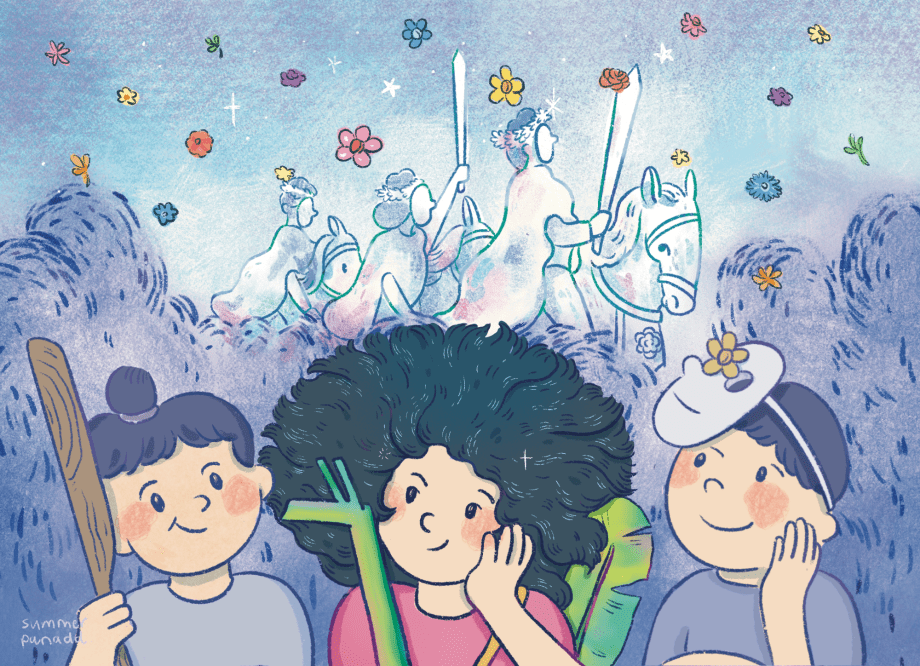
Illustrated by Summer Panadd
[คลิกที่นี่เพื่ออ่าน “นักรบแสนงาม” เป็นภาษาไทย]
“The Glorious Warrior” is a short interval in Prontip Mankhong’s memoir of her time in the Central Women’s Prison, All They Could Do To Us (มันทำร้ายเราได้แค่นี้แหละ). On the other 800+ pages of the book, Prontip writes a chronological account in the first person of what happened each day behind bars. But for this interval, she shifts from diary to fable, and from the concrete to fantasy. As a reader, it is impossible to not immediately seek comparison: who is Soo, who are the demons? But I (as one of those readers who tried to do just this) want to suggest that these are not the urgent metaphors contained in this fable.
Prontip spent 744 days behind bars between August 2014 and October 2016 after being convicted of violation of Article 112 of the Criminal Code for performing in a play, “The Wolf Bride,” in October 2013. Article 112 defines the crime and stipulates the punishment for lèse-majesté: “Whoever defames, insults, or threatens the king, queen, heir-apparent or regent shall be punished with three-to-fifteen years imprisonment.” Her accusers claimed that the play defamed the monarchy. Her arrest and prosecution were part of a wave of 169 convictions during the five-year dictatorship of the National Council for Peace and Order (NCPO), which came to power in the 22 May 2014 coup, Thailand’s thirteenth since the end of absolute monarchy in 1932. Like nearly all of those accused of violation of Article 112, Prontip was repeatedly denied bail while awaiting trial. Aware that a guilty verdict was likely, Prontip and her codefendant, Patiwat Saraiyaem, chose to plead guilty, which resulted in a halving of their sentence from five years to two-and-a-half years in prison.
In Article 112 cases, as well as in “The Glorious Warrior,” speaking the truth is no promise of liberation. This has only intensified in the years since the book’s publication in 2019. In 2020, youth-led protests demanded democracy and reform of the monarchy. After several months in which both seemed possible, a harsh crackdown ensued. Since then, nearly 300 people have been accused of lèse-majesté and political prisoners are filling the prisons as the cases are adjudicated.
The powerlessness of truth – not the identity of Soo or the demons – is the central metaphor of this fable. What, then, is the lesson Prontip aims to teach her readers? I am reminded of the words of the poet Audre Lorde, who wrote in her manifesto for poetry, “Poetry is Not a Luxury,” that “Sometimes we drug ourselves with dreams of new ideas. The head will save us. The brain alone will set us free. But there are no new ideas still waiting in the wings to save us as women, as human. There are only old and forgotten ones, new combinations, extrapolations and recognitions from within ourselves, along with the renewed courage to try them out. And we must constantly encourage ourselves and each other to attempt the heretical actions our dreams imply and some of our old ideas disparage.” One of these heretical actions in a time when the meaning of truth has dwindled is to don the sparkle suit and the faith in its power that Soo, the glorious warrior, carries. She does not renounce her truth even when no one stands with her. She remains a warrior even when she is delivered to the demon’s door. Perhaps this courage is the only way for Soo, us, and the polities we inhabit to survive.
Another excerpt of All They Could Do To Us was published by the Asian American Writers’ Workshop here. A full English translation of the book is complete and will hopefully soon find a publisher.
The Glorious Warrior
Once upon a time, a wizened spinner of fables sat and spun a fable by the side of the road.
“One day, when the dark shadows of demons take over the city, the light of the glorious warriors will once again lead the battle for those in the city. The sparkle army will come to protect the impoverished. They will proclaim the truth to the people. They will lead the people to see the hidden evils lurking. They will transform the people frozen upon stone plinths into monkeys running and screeching in the streets. The glorious warriors will rain down blows on the oppressors with a field of flowers and the sound of the wind. They will stay by the side of all those who struggle.” The storyteller walks on with his jar of coins, leaving the seated children smiling, absorbed in the dream vision of the legendary glorious warriors. They begin to pick up branches to use as swords and chase after one another. They pretend that one side are demons and the other are warriors. They fill the streets with peals of laughter.
And then the war begins. The demons dwelling in the bodies of humans take up guns and begin to kill each other. The impoverished die in droves from the fighting and from hunger. Under the demons’ influence, some people forget that they are human. Soo, a little child with a halo of fluffy hair framing her face, sits behind a bunker and waits for the arrival of the glorious warriors. She hopes that they will appear as she runs to escape the acid rain dropping from the sky. The battle begins to let up. The children wait to see if the warriors will come out to tell the truth of who killed their families. But – the warriors do not come. The demons possess the city. The sky is a starless inky black. Ordinary folks must hide. The demons control all.
“Where did the warriors go? Why haven’t they come?” Soo runs to ask the storyteller as soon as the dust of gunpowder begins to settle. More children run up to him and cry out, “Why don’t they appear?” The children tug on the storyteller’s arm and pull on his shirt. Soo peers at the old man’s face with her reddened eyes gleaming with tears, “They are probably old, and cannot come, maybe?” The storyteller’s face is motionless. “And do they not have any descendants?” another child cries out. Silence. No answer. The children keep asking until it becomes an uproar. They ask because they do not want to accept defeat. They ask because they do not want to accept that “They– will not come.” The storyteller ever so slowly turns his gaze from the horizon and reaches down to pry the dirty little hands of the children from his body. He gives no answer to the questions and walks on with his jar of coins. The children turn their faces to the ground and scatter.
Soo, the fluffy-haired child, walks into her falling-down house all deflated. She buries herself under a blanket – the best shelter to protect her hopes. The marks of clashes are everywhere outside. Safe under the blanket, the little child thinks and dreams of the glorious warriors. Who is going to tell the story of the demons taking over the city this time for those outside the city walls to hear? Will they know that nearly half the people are now demons, their bodies indistinguishable from humans? “Why?” Soo tosses and turns in her nest, asking “why?” in her head. She turns this way and that and does not know which way to turn next. Right. There is nowhere to go inside this nest of protection. Then the nest opens. No answers can be found from staying inside the nest. Soo stares at the ceiling before her nose detects an odd smell. The smell of a water truck spraying a cleaning solution on the city streets. She throws off the blanket and struts down from the bed. She washes her face and goes downstairs. Her parents are asleep in front of the blaring television. “What is it like outside now?” The best way to find out is to go take a look.
Stepping outside after the clashes is very distressing. Soo tiptoes out of the house on the softest of tiptoes she can manage. She slips out and scuttles to hide around the corner of a building only to find several children already hidden there. It is normal for children to be curious. “If only glorious warriors existed just like the old man said,” one child says. “If only.” Then Ai Juk, a little one, yells out, “Let’s go vanquish the demons.” A stick in hand he runs out to fight with the imaginary demons before other children follow suit. Each brandishes a sword, swooshing and swaying with the wind. The people who had hidden themselves come out to see the children. The joy fills the hearts of the dejected until they let down their guards and clap their hands. Well! This energizes the children’s hearts. But they cannot play for long because they have to go home. Before they leave, Soo tells her friends about the plan for tomorrow.
The next morning, amidst the chaos and confusion of people still perplexed by what took place, a glorious warrior appears clothed in white wielding a bouquet of flowers and the truth of what took place. She is accompanied by tinkling sounds of music summoning people to come out and look. The lithe, masked warrior is flanked by a cavalry on miniature horses and tens of foot soldiers. The people yell out their welcome and begin to muster the courage to speak to one another. But when the wind carries the sound of orderly steps closer, every being disperses, including the tiny glorious warriors. Hey! Who would stay behind to get arrested?
Before long, rumors about the glorious warriors proliferate. Their beauty and courage creates hope for the people, incredibly enough. Some say that they are descended from glorious warriors in the past. Others say that they represent a new force of humanity. Soo and other children delight in their role. “If we can make people hopeful, the demons can’t do anything to us,” Soo tells her friends. Right at that moment, the children’s eyes widen at the sight of a majestic, glorious army many-fold more dazzling than their tiny army. The glorious warriors are moving, moving, moving past them. Where are they going? Why aren’t they entering the city? Soo yells out to them, “We are here. The impoverished ones are here.” But her voice, their voice, is probably too small and faint for anyone to hear. Soo’s pretend glorious army can only drop their jaws and stare as the genuine article passes by. “When will we be as mighty as they?” A small voice asks. The beautiful image remains engraved in their hearts. It is not at all easy to be a legendary army, not at all easy for a fake army to rouse people’s spirits.
“We are the descendants of the glorious warriors. Of course we can do it.” Soo tells her friends. She repeats it until she believes it to be true, that she herself is a rightful heir of the warriors, even though she is not. At this point, some of the children stop having fun and ask to go home. But some have no home to return to and will continue to be warriors in this army. Taking on the hope of the people gives life force to the children and the children in turn give life force to the people.
But light cannot conceal itself. The demon army finds out about the glorious warriors and knows, too, that they are not actually the glorious warriors. The demons catch the children and strip away their disguises, taking off their masks and beautiful clothes. After that, the demons reveal the truth through their wily methods. Those warriors that everyone saw are just kids’ make-believe. Rumors spread. Reproaching stares and a volley of curses follow. But no sound can cut to the heart as much as the voice of the legendary warriors whom they held up as their role model.
Upon seeing the heroic warriors, the children thought that they had come to help. But not at all. They have come only to deny and denounce. “We have nothing to do with this group of children. And their fake, ragtag army has damaged our reputation.” As the head of the fake warriors, Soo is sentenced to run the gauntlet of demons. If she survives, then she survives. If she doesn’t survive, then she doesn’t.
Many who were disappointed come to curse Soo at the plaza at which she is delivered to her punishment. “Cheat – fake.” But another lot came to encourage the little child. And, amidst the staring onlookers, the glorious warriors of legend are present. Soo explodes and words tumble out. She hopes that the legends will hear her.
“What do you care? No matter what, you won’t be smeared with anything. Me—I did it. We did it all. Where were you? Why didn’t you come? Even though it is your image that I pulled from a story, but don’t you worry. You won’t be sullied. You will still be clean and beautiful as in the legend. The mud is on me, not you.” No reaction or answer of any kind from the glorious warriors.
Soo is exiled. We don’t know if she will survive to return. But at least the warriors in the fake army learned how to fight on an actual battlefield. The legends are still legends. Without legends, they would not exist. Legends can no longer be courageous when the time and era has changed, because they are merely and only legends.
 Sanam Ratsadon
love it!!!
LikeLiked by 1 person