Based on lectures in prison by Samak Burawas, Kulap Saipradit, and Suphat Sukhonthaphirom
Written by Suphot Dantrakul
Translated by Tyrell Haberkorn
Illustrated by Summer Panadd
[คลิกที่นี่เพื่ออ่าน “ความคิดทางชนชั้นกับการปฏิวัติแบบเพ้อฝัน” ในต้นฉบับภาษาไทย]
Suphot Dantrakul, born into an ethnically Chinese family in southern Thailand in 1923, was arrested in November 1952 along with 103 others on the charge of rebellion. Lumped together by the authorities as a communist-linked “Peace Revolt,” those arrested were writers, publishers, students, farmers, workers and soldiers. Some were indeed communists, others were socialists, and many, like Suphot, were unaligned leftists. Initially sentenced to thirteen years and four months in prison, Suphot was released with many others in an amnesty in January 1957 after living behind bars for over five years.
In late 1958, after Sarit Thanarat’s second coup, he was arrested and accused again of rebellion and also violation of the Anti-Communist Activities Act (ACAA). This time, his crime was writing a series of newspaper articles serialized into a book about the movement that led to his first arrest. The ACAA charge was dropped but the rebellion charge stuck. He was convicted and sentenced to three more years in prison.
Upon release, Suphot was not deterred from either challenging injustice or bearing witness to the truths he thought and experienced. He spent the rest of his life writing and writing and writing, and published over 100 books by the time he died in 2009. Most observers credit Suphot’s primary contributions to Thai political thought to be his identification of Pridi Banomyong as the main architect of the transformation from absolute to constitutional monarchy in 1932 and the subsequent struggle for democracy, his rigorous empirical work about the mysterious death of King Rama VIII in 1946, and his searing yet hopeful history of the constitution. He also wrote about communism, Buddhism, Siriraj Hospital, and many other topics.
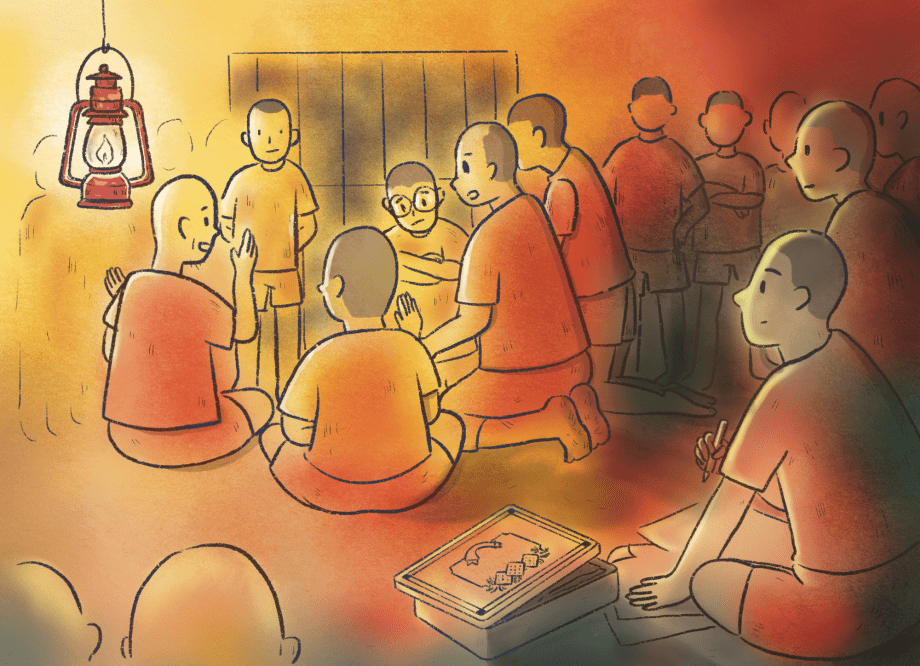
Here, Sanam Ratsadon wishes to share two entries from Suphot’s A People’s Political Lexicon (ปทานุกรมการเมืองฉบับชาวบ้าน), a book he wrote during his first stint in prison and spirited out following the amnesty in a cream cracker box. The heterogeneous group of leftists bound together behind bars debated, lectured, and shared knowledge of ideas, literature and language with one another. Suphot turned this exchange into A People’s Political Lexicon. Comprised of short essays about forty-three words that animated the politics of the time, such as “class conflict” and “bourgeoisie,” and critical perspectives on ordinary words, such as “law,” “king,” and “history,” a critique of the status quo and an outline of what a just relationship between the rulers and the ruled would look like emerges between the lines of the at-times doctrinaire left definitions current in the 1950s.
In A People’s Political Lexicon, Suphot does not merely transcribe the lectures he listened to in prison. He charts a different Thai society and a different world, which he continued writing towards – dreaming it up on paper – for the rest of his life. The two entries selected and translated here – “Class-Based Ideas” and “Utopian Revolution” – outline the path towards liberation as one in which there is no separation between the people and the leaders. The material and the ideal must always be intertwined, yet neither determines the other. One learns about the material, Suphot explains, not “from sitting in an armchair, but from engaging in the production of various items in accordance with one’s needs.” The deliberate intention needed to understand material production, meanwhile, is no less urgent to kick-start the struggle for a new society. Revolution is planned and must be concrete, not a dream come true. Suphot writes that, “Despite the universal acceptance of this truth, some observed the ongoing revolution by spontaneous uprisings of the masses and took them to be a fundamental aspect of the revolution: that it would happen automatically without any need for preparation or plan, like the rising and setting of the sun.” The leaders do not, and cannot, stand above – or behind – the people.
The lessons remain as relevant today as they were when Suphot penned them.
Class-based Ideas
Concomitant with the expansion of capitalist production, conflict arose in feudal relations. That is to say, in the new mode of production, capital is the most important factor in practice, which it was not in the feudal economic system, as we have seen. Conflict, then, arose between various ideas born from these two economic systems. For example, capitalism does not accept magical ideas about the divine right of kings, but holds to the maxim that “there can be no taxation of the people without the people knowing and seeing it” (NO TAXATION WITHOUT REPRESENTATION).* The new ideas require the right to free trade, a new imagination of religion, reverence for the rights of the individual and reduction of centralized authority. However, what appears to be a fight by free men prepared to sacrifice their lives for rights and a form of religion, that is to say abstractions, is actually a struggle between the two systems. These are the capitalist economic system that is growing and the feudal economic system that is falling into ruin. The clash of ideas is merely a secondary cause.
*The capital letters in parentheses are in English in the original. –trans.
Scientists of history therefore do not hold to the principle that society is organized on the basis of the abstract, like the idealist writers do. The science of history considers that all such “principles” that appear in human thinking are merely the reflection of the social organization that exists in a given time and place, and that such “axioms” will not be able to facilitate a good outcome always and everywhere. Further, some ideas that appear to be universal, such as the idea of equality among humans, do not hold the same meaning in different societies and eras. For example, ideas about equality and rights did not extend to slaves in the Greek city-state. The slogan of the mighty French Revolution – “Liberty, Equality, Fraternity” – only referred to the liberty to freely trade of the emergent capitalist class, equality for this newly formed class, and the fraternity of those who comprise this class. This fraternity took the form of cooperation to oppose the oppression and limitation of rights by the class of feudal lords.
We can therefore see that the majority of ideas, especially those related to the organization of society, are class-based ideas: the thinking of the class that has the power to dominate society and the power to enforce their ideas upon other classes. This class uses their instruments of propaganda, their control of education and their power to punish the expression of ideas that conflict with theirs via the courts, dismissal from positions, and other methods in the same vein.
Such practices do not mean that the socially dominant class acknowledges to themselves that, “The ideas we offer up have no basis in truth, but we will enforce them on others, or at the very least, shall not disavow them publicly.” The actual circumstances are otherwise. That class that held power did not invent the ideas. Such ideas arose on their own according to the form of government in place at that time, just as power was afforded under a certain political structure to the wealthy industrialists, who were made into nobles. This became the foundation for the idea that aristocrats are naturally greater than other people. Once such an idea arises and becomes entrenched, the dominant class at the time will deem it essential that all people accept and respect these ideas. If they do not do so, they will not act in accordance with them. For example, the people may express disdain towards the divine right of the king. The dominant class, no matter the era and no matter the country, will take every action they can to prevent allowing “dangerous ideas” to spread among the populace.
Someone may ask, if ideas are merely a secondary fact, and the important and primary fact must always take the form of material transformation of the mode of production, how can “dangerous ideas” arise? Or, in short, how can the people think of a new mode of production before it arises?
Following from the above questions, a social scientist explained that the people cannot think of it before the conditions connoting its existence take shape. But the people will be forced into thinking of it when such conditions appear in the clash between the old conditions and the new forces of production.
Another British pandit of history raised the example of how when production that depends on wage labor expands and the necessity to sell products for a profit arises, early capitalists sharply encountered the limitations of various rights to trade set by the feudal system. Therefore, ideas about freedom from the limitation of rights and the ideas to have the right and a voice in setting taxes and other matters arose. In that period, social conditions had not transformed into a capitalist society. What had appeared was only a symptom that would bring about such a society. From this very symptom, capitalist ideas about the economy arose.
It is the same with socialist ideas about the economy. Ideas in the form of scientific socialism (SCIENTIFIC SOCIALISM IDEAS), which are the opposite of utopian socialist ideas (UTOPIAN SOCIALISM IDEAS), will arise if and only if the symptoms of socialism unfold. The unfolding of the symptoms or the conditions will have occurred when large-scale production has diffused widely and the capitalist economy has most evidently become a hindrance to social progress. This most evident symptom takes the form of a crisis of production that overwhelms the market and causes buying power to decline. This occurs again and again.
Even if ideas must rely on material conditions to arise, once they arise they will exert influence on human action, and thus have influence over the course of events in general. Ideas born of the old mode of production depend on the existing traditions and hold back human action. For this reason, in every era, the class that possesses power does everything possible to inculcate their outmoded ideas into the people.
The progressive ideas that arise from the new conditions of production promote action by taking account of these new conditions to proceed to a new system. For this very reason, the dominant class holds progressive thinking to be a “dangerous idea.” Such as the idea that capitalism is bad because the capitalist system promotes cruel and brutal exploitation simply for the security and opulence of the capitalists, because it promotes the destruction of the abundance of food that exists simply to prevent the price of food from decreasing, while a great number of the people live in conditions of near-starvation.
In truth, the danger of the ideas deemed as “dangerous ideas” by the dominant class is merely the danger that will befall this class from the transformation to a new mode of production. In truth, those progressive ideas will lead to establishing a new mode of production, which is production for use and not production for profit. Therefore, it is a grave “danger” for groups that hope to seize profit for their personal wealth accumulation; it is not in any way a “danger” for the masses, who hope for the collective abundance and happiness of humanity.
The imagination of the scientists of history about the improvement of society, which is given the name of “the doctrine of historical materialism” (HISTORICAL MATERIALISM) is therefore not the same as the “doctrine” of materialism regarding the mind (MATERIALIST DETERMINISM), which is the theory that human action depends entirely on material conditions. The historical materialists hold a different view. They think that human action, along with the material changes that this action brings about, arises partly from external material conditions and partly from one’s own consciousness that figures out how to take charge of the material conditions.
But humans may only gain such knowledge from the experience of observing and studying material conditions themselves. One does not gain expert knowledge about material conditions from sitting in an armchair, but from engaging in the production of various items in accordance with one’s needs. As humans accumulate their knowledge from inventing new methods of production and putting them into practice, they will find that the existing form of social organization has become an obstacle preventing them from fully using the new methods that they have thought up. Humans realize this reality from the circumstances of their own lives. Therefore, initially, humans struggle against a particular set of pernicious ideas and obstacles constructed by the old form of social organization that they come across in their sphere of experience. But in time, they will be unable to avoid being pulled into an all-out struggle with the entire existing regime.
During one time period, the course of events that facilitates the unraveling of the old regime and the formation of new forces of production does so without consciousness and without planning. The same applies to the struggle against the old form of social organization that upholds the old regime: it breaks out without consciousness and planning. But there will always be a brief period in which the relationships or order that the pre-existing class set in place reveals itself clearly as an obstruction of the full implementation of the new forces of production. This is the precise period when the actions of the progressive class, those who hold the future in their hands, are manifested with consciousness.
And from this point on, the unfolding of the new forces of production will no longer be unconscious or unplanned. Humans have accumulated sufficient experience and knowledge about the laws of social transformation to advance to the next stage. With consciousness and planning, they will create a social foundation. They will limit production to things that are conscious and planned.
The pandit of history once said that
“The external forces which we cannot feel, that have the power to control human history up until the present, will come under the control of humans themselves. Only from this point can humans refashion history wholly through their own consciousness and realization.”
Utopian Revolution
Lenin coined this word while criticizing some members of the Social Democratic Party who held a utopian view of revolution, that is, building castles in the air. They merely studied theory without translating its essence into practice. The bits and pieces they translated into practice, they did only to gloat and hold themselves up as glorified experts.
In a meeting in London in April 1904, Lenin proposed the question of rising up in armed revolution to his supporters. When he returned to Geneva, he tried to advance this further upon noting that the tsars were uninterested in abdication. Lenin knew they would have to be overthrown by an armed revolution. This was a truth accepted by all socialists. Despite the universal acceptance of this truth, some observed the ongoing revolution by spontaneous uprisings of the masses and took them to be a fundamental aspect of revolution: that it would happen automatically without any need for preparation or plan, like the rising and setting of the sun.
Lenin’s view was that this simplistic understanding of such socialists was a Micawberish utopian view of revolution (Micawber was a magnanimous character in a Dickens novel). Lenin charged that such thinking would ultimately lead to opportunistic demagoguery.
“It’s the ultimate idiocy to kindle a revolution among the people, only to push them to fight for the revolution while those who lit the fire remove themselves and hide behind the people,” Lenin said.
Lenin further cautioned that, “Rising up to foment a revolution will succeed only when there is a constant assault. Being on the defensive will spell disaster.” He further pressed his supporters to organize a special military unit in the party.
Taking on Lenin’s recommendations, Koba (Stalin) said in the Proletariatis Brdzola,
“At present, many of our organizing organs have solved their practical problems and are aiming towards the use of force. The task at present is to arm the proletariat. Our struggle with the aristocratic regime has reached the stage where all recognize that we must be armed. But the recognition of such necessity is insufficient. The task of implementation should be raised and taken up widely by the party. Our committee should proceed with the arming of weapons. We should organize a factory for all kinds of explosive material and prepare a plan to seize all state and private armories and arsenals …. The quarrels among various subgroups, at the very least, should be arrested by the unification of the social democratic members coming together for this reason.”
 Sanam Ratsadon
2 thoughts on “Suphot Dantrakul and the Material of Revolution”